


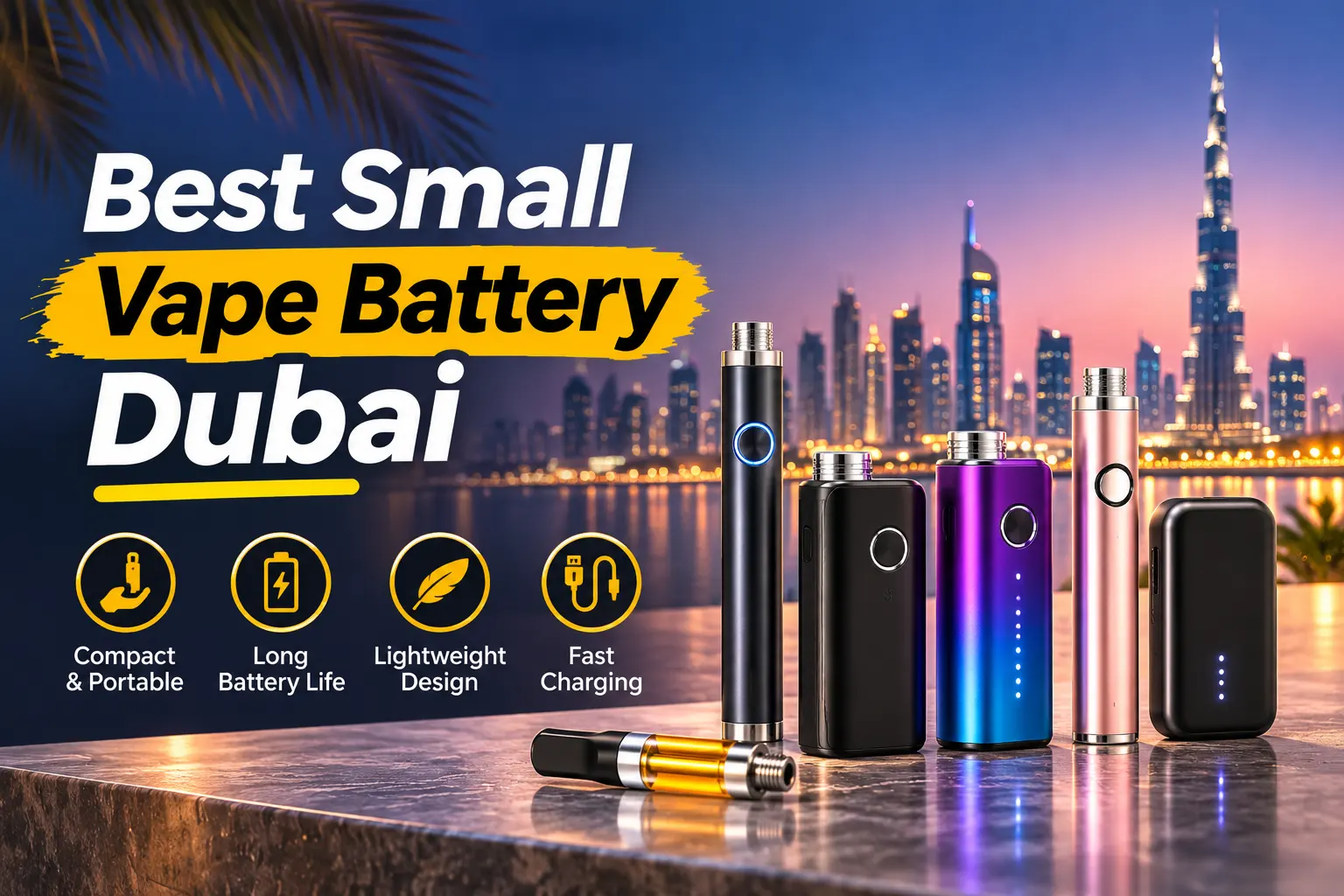
Searching for the best small vape battery in Dubai often means looking for information about compact devices, their battery technology, compatibility, and everyday safety considerations. However, a small size alone does not establish that a battery is reliable, compatible with a particular device, or safe to use.
Compact electronic devices can differ in their construction, charging systems, electrical specifications, and intended use. Understanding these differences helps readers assess product information without relying on marketing claims such as “ultra-portable” or “long-lasting.”
This guide explains what a small vape battery is, which specifications matter when evaluating product claims, how to recognise battery safety concerns, and what to consider regarding applicable rules in Dubai and the UAE.
You May Like: Best vape shop in Dubai
What Is a Small Vape Battery?
A small vape battery is a compact power source used in certain electronic vaping devices. Depending on the device design, the battery may be built into the unit or form part of a separate component.
Compact designs can reduce the physical size of a device, but they may also involve different battery capacities, charging arrangements, and electrical limitations.
The term small vape battery does not refer to one universal product specification. A mini device, a compact rechargeable unit, and a battery designed for a particular connector may all be described using similar language.
For that reason, product descriptions should be assessed against the manufacturer’s actual specifications rather than size claims alone.
What Features Matter When Evaluating Compact Battery Claims?
Several technical details help explain the differences between small electronic batteries. These are useful for understanding product documentation, not recommendations for choosing or using vaping equipment.
1. Physical dimensions
A compact battery has limited space for its internal components. Product dimensions may help explain the overall design, but a smaller enclosure does not automatically indicate better construction or greater safety.
2. Battery capacity
Capacity is commonly expressed in milliampere-hours (mAh). It describes a battery’s electrical charge capacity under specified conditions, but it does not independently establish runtime, battery quality, or safety.
Actual performance can depend on the device’s power demands, electronics, battery condition, and operating conditions.
3. Charging specifications
Charging requirements differ between devices. A connector that physically fits does not prove that a charger is suitable.
The manufacturer’s charging instructions and stated electrical requirements are important for understanding whether a charging arrangement is appropriate.
4. Protection and product documentation
Reliable documentation should identify the manufacturer and model and explain relevant electrical and charging requirements. Where applicable, product safety information should also describe the device’s protections and limitations.
Do not assume that a product has adequate protection simply because its packaging uses terms such as “smart,” “advanced,” or “premium.”
5. Intended compatibility
Some batteries are designed for specific devices or connector formats. A matching connector does not guarantee complete electrical or mechanical compatibility.
Manufacturer documentation is the appropriate source for determining the components a product is designed to work with.
Compact Battery Size vs. Battery Capacity
Small size and high capacity are different characteristics. A compact battery’s available space can limit the physical size of its cell, but the relationship between dimensions and capacity depends on its design and technology.
| Specification | What it tells you | What it does not prove |
| Physical dimensions | The battery or device’s size | Overall safety or quality |
| Capacity (mAh) | Rated electrical charge capacity | Exact runtime in every situation |
| Charging requirements | Stated charging conditions | That every similar-looking charger is suitable |
| Connector type | The connection format | Complete component compatibility |
| Manufacturer documentation | Product-specific details and instructions | That unsupported marketing claims are true |
A useful product description should explain these specifications clearly and consistently. If information is missing or contradictory, it is difficult to evaluate the product reliably.
Battery Safety: Important Warning Signs
Small rechargeable batteries can still present hazards if damaged, improperly charged, or affected by a manufacturing defect. Lithium-ion batteries, in particular, require suitable design and handling.
Watch for warning signs such as:
- Swelling or a change in the battery’s shape.
- Cracks, punctures, or other physical damage.
- Leakage or unusual corrosion.
- Unexpected overheating.
- Abnormal charging behaviour.
If a battery-powered device shows signs of damage or overheating, stop using it. Do not puncture, crush, dismantle, or attempt to repair the battery. Follow the manufacturer’s instructions and relevant local guidance for safe handling.
Charging safety
Use charging equipment only as specified by the manufacturer. A cable or connector fitting physically does not guarantee that the charging arrangement is electrically appropriate.
Do not charge a damaged device or ignore manufacturer warnings. If a battery becomes unusually hot, stop using the device and follow the manufacturer’s safety guidance.
Does a Smaller Vape Battery Mean Better Portability?
A smaller device may occupy less space, but portability is only one aspect of its design. Physical size does not establish that a product is reliable, suitable for a particular application, or safe.
When reading descriptions of compact electronic devices, distinguish between measurable information and promotional language.
- Measurable information: Dimensions, stated capacity, charging requirements, and model identification.
- Claims requiring evidence: Exceptional durability, superior safety, universal compatibility, or unusually long performance.
- Information that should not be inferred: Overall product quality based solely on size, appearance, or price.
These distinctions are useful when evaluating any compact battery-powered product.
How to Check Product Information in Dubai
For readers researching small electronic vaping devices in Dubai, reliable documentation matters more than marketing slogans.
Confirm the product identity
Check the manufacturer’s name, exact model, and product specifications. Generic listings may use similar names for devices that have different designs or requirements.
Review the safety information
Look for clear charging instructions, battery warnings, and relevant product documentation. Be cautious of listings that omit the manufacturer or make broad safety claims without supporting information.
Verify compliance claims
A product page or retailer statement does not, by itself, prove regulatory compliance. Check whether the claimed standards or approvals are relevant to the exact product and supported by credible documentation.
Check current UAE rules
Requirements may depend on the product category, applicable technical standards, import conditions, and other circumstances. Consult current official UAE government information and relevant authorities rather than assuming that a device is permitted because it appears online.
Age restrictions and rules governing where vaping is permitted may also apply. Anyone below the legally permitted age should not attempt to obtain or use vaping products.
Common Myths About Small Vape Batteries
Myth 1: Smaller batteries are always safer
Fact: Physical size alone does not establish battery safety. Design, construction, condition, charging requirements, and appropriate protection all matter.
Myth 2: A higher mAh rating guarantees longer runtime
Fact: Capacity is only one factor. Actual runtime depends on the device’s power requirements and operating conditions, among other factors.
Myth 3: Every compact battery uses the same charger
Fact: Charging requirements vary. Use only equipment specified as suitable by the manufacturer.
Myth 4: A premium price proves product quality
Fact: Price is not proof of authenticity, safety, or regulatory compliance. Reliable documentation is more informative.
Myth 5: A matching connector guarantees compatibility
Fact: Physical fit does not necessarily establish that two components are electrically or mechanically compatible.
Health and Environmental Considerations
Battery safety is only one part of the broader issue surrounding electronic vaping products. Depending on the product, vaping may expose users to nicotine and other substances in inhaled aerosol. Nicotine can cause dependence, and aerosol exposure can carry health risks.
A compact design or a claim about battery quality does not make vaping harmless. People who do not already vape should avoid starting.
Disposable or damaged electronic devices can also create waste-management concerns. Batteries and electronic components should be handled according to local guidance rather than casually discarded or dismantled.
You May Like: Can I bring vape to Dubai airport
Frequently Asked Questions
1. What is considered a small vape battery?
The phrase generally refers to a compact battery used in an electronic vaping device. There is no single universal size threshold, so the exact dimensions and specifications depend on the model.
2. Does a smaller battery have less capacity?
Not necessarily in every case, but physical space can constrain battery design. Capacity should be checked from reliable product documentation rather than inferred from appearance.
3. Does a higher mAh rating mean a battery is safer?
No. The mAh rating describes electrical charge capacity, not overall safety, manufacturing quality, or compatibility.
4. Can every small vape battery use the same charger?
No. Charging requirements vary between devices. Follow the specific manufacturer’s instructions and do not assume that a physically compatible connector is sufficient.
5. Are small vape batteries legal in Dubai?
The applicable rules depend on the product and current UAE requirements. A compact size or online listing does not establish that a product can legally be imported, sold, or used.
6. What should I do if a small rechargeable battery overheats?
Stop using the device and follow the manufacturer’s safety instructions. Do not dismantle, puncture, or attempt to repair the battery. Seek appropriate assistance if the device appears damaged.
7. Does a small vape battery make vaping safer?
No. Battery dimensions do not remove the health risks associated with vaping aerosol or nicotine exposure. Compactness should not be treated as a health or safety benefit.
Conclusion
The phrase “best small vape battery Dubai” relates to searches for compact vaping-device batteries, but there is no single specification that establishes which product is best or safest.
Understanding dimensions, capacity ratings, charging requirements, compatibility limitations, and credible product documentation gives readers a clearer way to assess claims. In Dubai, it is also important to check current UAE requirements and take battery warnings seriously.
For an informational resource such as Best Vape Shop in Dubai, accurate specifications, transparent sourcing, and responsible safety information are more useful than unsupported product rankings or claims that any vaping device is risk-free.