


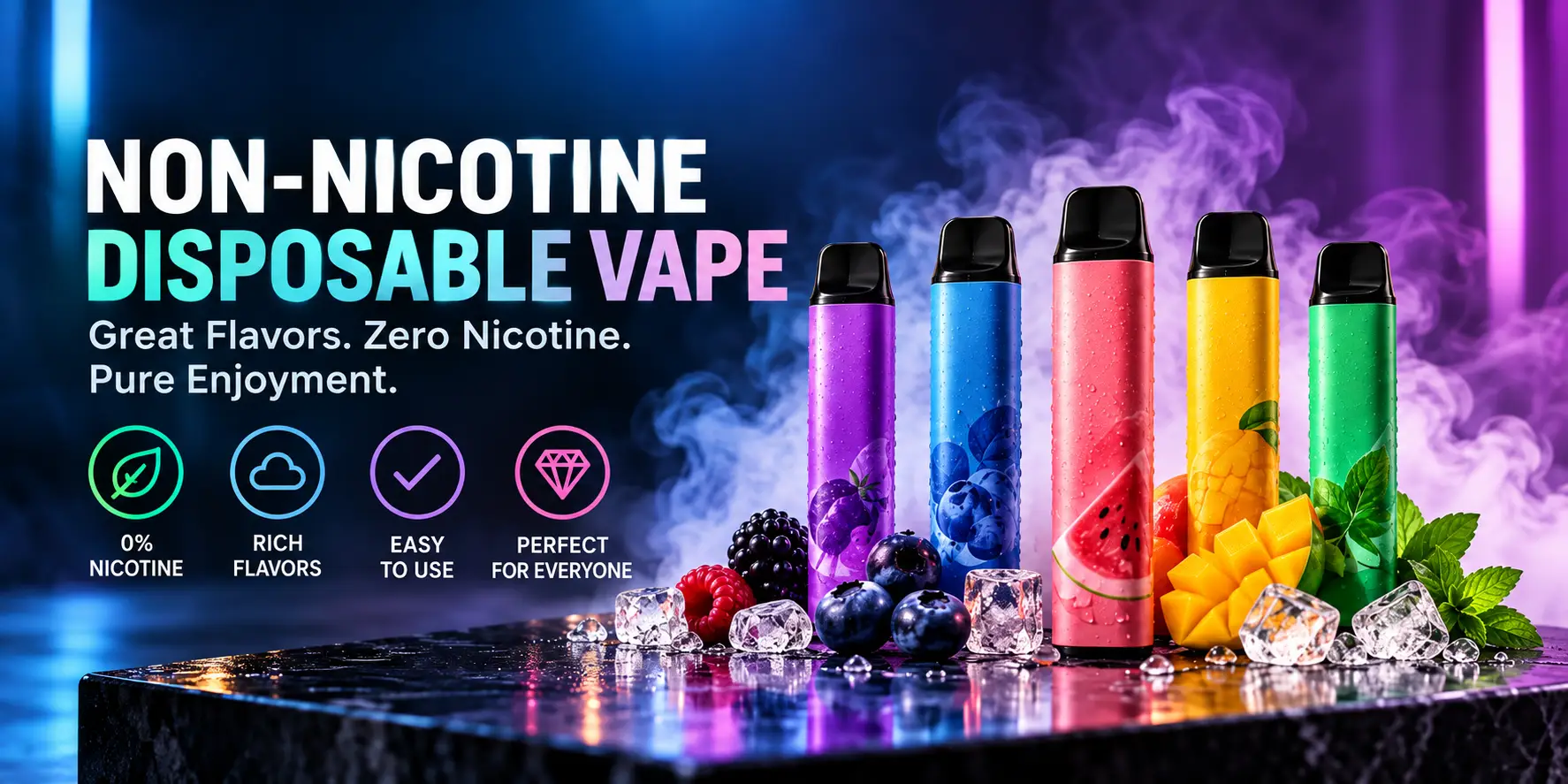
A non-nicotine disposable vape is an electronic vaping device marketed as containing no nicotine. These products may appeal to people who are curious about the difference between nicotine-containing and nicotine-free vaping products. However, the label “nicotine-free” does not automatically mean that a device is harmless.
Before relying on a product description, it is important to understand what these devices contain, how nicotine-free claims can be verified, what health concerns remain, and which rules apply in Dubai and across the UAE.
This guide explains the essential facts in straightforward language. It is intended to help readers evaluate product claims and understand the risks—not to recommend vaping or suggest that nicotine-free products are safe.
You May Like: Best vape shop in Dubai
What Is a Non-Nicotine Disposable Vape?
A non-nicotine disposable vape is a single-use electronic device advertised as using e-liquid without nicotine. Like other electronic vaping products, it generally uses a battery to heat a liquid and produce an aerosol that the user inhales.
The term disposable means the device is designed to be discarded when its usable liquid or battery supply runs out, rather than being refilled or recharged by the consumer. Product designs vary, so the exact features depend on the model.
A product marketed as nicotine-free may still contain other ingredients, including flavouring substances and carrier liquids. The resulting aerosol can also contain substances produced during heating.
The key distinction: “Nicotine-free” describes a claim about one ingredient. It is not a guarantee that the product is free from other potentially harmful substances or that inhaling its aerosol is risk-free.
What Ingredients May Be Found in a Nicotine-Free Disposable Vape?
The ingredient list varies by manufacturer and product. Packaging and online descriptions may not always provide enough information to establish the full composition of a liquid or its aerosol.
Commonly reported ingredients include:
1. Propylene glycol
Propylene glycol is used as a carrier liquid in many vaping products. It helps distribute flavouring ingredients and contributes to aerosol formation.
Its use in certain regulated food, cosmetic, or pharmaceutical applications does not establish that inhaling it repeatedly through a heated device is safe.
2. Vegetable glycerin
Vegetable glycerin is another liquid commonly used in e-cigarette formulations. It can contribute to the visible aerosol produced by a device.
Heating a liquid can change its chemical composition. Therefore, the safety of an ingredient when used in one context should not automatically be assumed to apply to inhalation.
3. Flavouring ingredients
Some nicotine-free vape products are advertised with fruit, mint, dessert, or beverage-inspired flavour descriptions.
A flavouring ingredient considered suitable for a particular food application is not necessarily suitable for inhalation. The relevant safety question concerns the specific substance, its concentration, and how it behaves when heated.
4. Other substances
Depending on the device and formulation, the liquid or aerosol may contain additional chemicals. Heating conditions and device components can also affect what is released.
Without reliable product-specific testing, a consumer cannot determine the complete chemical composition of an aerosol from its flavour name or packaging alone.
Does “0 Nicotine” Mean a Product Is Completely Safe?
No. A nicotine-free claim does not establish that a vaping product is harmless.
There are several reasons for this distinction:
- Aerosol exposure: The aerosol may contain particles and chemicals that can irritate or affect the respiratory system.
- Heating by-products: Heating liquid ingredients can produce additional compounds, depending on the formulation and operating conditions.
- Flavouring uncertainty: Not every substance suitable for ingestion has been shown to be safe to inhale.
- Product quality: Poor manufacturing, contamination, inaccurate labelling, or inconsistent quality control can create additional concerns.
- Uncertain long-term effects: The long-term health effects of many vaping exposures are still being studied.
Vaping is not the same as breathing clean air. Removing nicotine from a formulation does not remove every potential risk associated with the device, liquid, or aerosol.
For people who do not already vape, starting with a nicotine-free product is not a risk-free choice.
Non-Nicotine Disposable Vape vs. Nicotine-Containing Vape
The most obvious difference is whether the liquid contains nicotine. However, the distinction does not tell the whole safety story.
| Feature | Marketed nicotine-free disposable vape | Nicotine-containing disposable vape |
| Nicotine | Advertised as containing none | Contains nicotine |
| Nicotine dependence | Does not have the same intended nicotine-dependence mechanism if genuinely nicotine-free | Nicotine can cause dependence |
| Other aerosol exposures | Still possible | Still possible |
| Flavouring ingredients | May be present | May be present |
| Battery and electronic waste | Generated when discarded | Generated when discarded |
| Overall safety | Not risk-free | Not risk-free; nicotine adds further risks |
A product’s actual composition matters. The table describes the intended distinction, not a guarantee that every product label is accurate.
How Can Nicotine-Free Claims Be Evaluated?
A label or advertisement is not conclusive proof of a product’s contents. If you are researching a particular device, consider the quality and credibility of the available evidence.
Check the full ingredient information
Look for a clear ingredient declaration, manufacturer details, batch identification, and relevant product documentation. Be cautious when descriptions use broad terms such as “natural,” “clean,” or “pure” without supporting evidence.
Look for credible testing information
Independent laboratory testing may provide evidence about whether a product contains nicotine and whether it meets specified quality requirements. Check that the report identifies the relevant product and batch, explains what was tested, and comes from a credible laboratory.
A test for nicotine alone does not establish that every other ingredient or the resulting aerosol is safe.
Verify the manufacturer and product identity
A legitimate-looking website, attractive packaging, or QR code is not sufficient on its own to prove authenticity. Product details should be consistent across the packaging, manufacturer information, and applicable regulatory documentation.
Be cautious with absolute safety claims
Statements such as “100% safe,” “risk-free,” or “healthy vaping” should not be treated as reliable evidence. A nicotine-free product can still expose a person to aerosol chemicals and other hazards.
What Are the Health Concerns Associated With Nicotine-Free Vaping?
Removing nicotine may reduce exposure to that particular substance if the product truly contains none. It does not eliminate the other concerns associated with inhaling vaping aerosol.
Respiratory irritation
Some aerosol constituents can irritate the throat and airways. People may experience coughing, throat discomfort, or other symptoms, although the effects vary by individual and exposure.
Exposure to chemicals produced during heating
The substances in an e-liquid can change when heated. The chemicals released depend on the ingredients, device design, temperature, and operating conditions.
This is one reason why an ingredient list alone cannot fully describe the health risks of inhaling a product’s aerosol.
Uncertainty about repeated exposure
Evidence about the long-term effects of different vaping formulations continues to develop. A lack of definitive evidence about a particular product is not proof that it is safe.
Risk of misleading product claims
If a product is incorrectly labelled or its composition is uncertain, consumers may be exposed to ingredients they did not expect. Marketing terms should not replace reliable evidence.
Practical takeaway: The absence of nicotine does not make inhaling a disposable vape equivalent to breathing clean air.
Non-Nicotine Disposable Vapes in Dubai and the UAE
Anyone researching electronic vaping products in Dubai should consider the UAE’s applicable product and public-health rules rather than relying solely on claims made by a seller.
Requirements can differ depending on the product category, applicable technical standards, import arrangements, sale restrictions, and the circumstances of use. Regulations and official guidance may also change over time.
Verify applicable UAE requirements
For current information, consult official UAE government resources and relevant authorities responsible for product standards, customs, public health, and tobacco-related regulation. Do not assume that a product is lawful merely because it is listed on a website or advertised locally.
Do not assume nicotine-free products are exempt
A claim that a product contains no nicotine does not automatically establish that it falls outside applicable electronic-vaping rules. The device type, product classification, and other legal requirements may still matter.
Check age restrictions
Vaping products are subject to age-related restrictions and other rules. Anyone under the legally permitted age should not attempt to obtain or use these products.
Consider public-use restrictions
Rules governing where vaping is permitted may apply independently of whether a product is advertised as nicotine-free. Check current official guidance before making assumptions about use in public places.
Treat retailer claims as claims, not proof
For information published on a Dubai-focused website, distinguish clearly between verified facts, manufacturer statements, and general health information. Avoid claiming that a retailer, product, or device is approved unless reliable, current evidence supports that statement.
Disposable Vape Waste: Batteries, Plastics and Environmental Impact
Nicotine-free disposable vapes can still create electronic waste.
Their components may include a battery, electronic circuitry, a heating element, plastic housing, and residual liquid. Throwing a device into ordinary household waste can create handling and environmental concerns, particularly when a battery is damaged or crushed.
Responsible waste handling includes:
- Following local guidance for electronic waste and battery disposal.
- Using an authorised collection or recycling route where available.
- Avoiding dismantling, puncturing, or crushing the device.
- Keeping damaged battery-powered devices away from heat and following local safety instructions.
The word disposable describes the product design; it does not mean the device has no environmental consequences.
Common Misunderstandings About Nicotine-Free Vapes
Myth 1: No nicotine means no health risks
Fact: Nicotine is only one possible source of risk. Aerosol chemicals, flavouring substances, heating by-products, and product-quality issues remain relevant.
Myth 2: Food-grade ingredients are automatically safe to inhale
Fact: Safety depends on how a substance is used. Evidence for ingestion does not automatically establish safety when the substance is heated and inhaled.
Myth 3: A high puff count proves better quality
Fact: Puff-count claims do not establish ingredient accuracy, manufacturing quality, regulatory compliance, or health safety.
Myth 4: Nicotine-free products are automatically legal everywhere
Fact: Legal requirements depend on the applicable jurisdiction and product classification. A nicotine-free label is not a substitute for checking current UAE rules.
Myth 5: A product is safe because it is popular online
Fact: Popularity, reviews, and social media recommendations do not verify a product’s composition or safety.
You May Like: Best vape tank for flavor
Frequently Asked Questions
1. What is a non-nicotine disposable vape?
It is a single-use electronic vaping device marketed as containing e-liquid without nicotine. It may still contain carrier liquids, flavouring ingredients, and other substances that can contribute to aerosol exposure.
2. Is a nicotine-free disposable vape safe?
It should not be considered risk-free. Even without nicotine, inhaling aerosol from a vaping device can expose the respiratory system to potentially harmful substances. Avoid starting vaping for health or lifestyle reasons.
3. Does 0 nicotine mean a vape contains absolutely no nicotine?
Not necessarily. The phrase is a product claim. Reliable, product-specific testing provides stronger evidence than packaging alone, although testing for nicotine does not prove overall safety.
4. Can a nicotine-free vape still cause throat irritation?
Yes. Some ingredients or aerosol constituents may irritate the throat and airways. The likelihood and severity depend on factors such as the formulation, exposure, and individual sensitivity.
5. Are non-nicotine disposable vapes legal in Dubai?
Do not assume that they are automatically permitted because they are advertised as nicotine-free. Check current UAE rules and relevant official guidance for the specific product category and circumstances.
6. Are nicotine-free disposable vapes suitable for people who have never vaped?
There is no health reason to start inhaling vaping aerosol simply because a product claims to contain no nicotine. Avoiding vaping altogether prevents exposure to its associated aerosol and device-related risks.
7. How should disposable vape devices be discarded in the UAE?
Follow current local electronic-waste and battery-disposal guidance. Use an appropriate authorised collection route where available, and do not dismantle or crush a device to dispose of it.
Conclusion
A non-nicotine disposable vape is marketed as a single-use vaping device that contains no nicotine, but that label answers only one question about its composition. It does not establish that the product is harmless, accurately labelled, or automatically permitted under UAE rules.
Readers in Dubai should look beyond marketing language, distinguish product claims from verified evidence, consider the health and environmental implications, and consult current official guidance when assessing regulatory requirements.
For an informational website such as Best Vape Shop in Dubai, the most useful approach is to provide clear, evidence-aware explanations without presenting nicotine-free vaping as a safe habit or making unsupported claims about product quality or legal approval.